
A backyard that felt chaotic - and the two changes that gave it direction
A homeowner with a wooded backyard had collected plants for years but still felt something was wrong and could not name it. In one Garden Direction Session, we found the two things holding the space back - and left with a clear plan she could act on herself.
- Location
- Wilmington, North Carolina
- Client
- Rachel
- Project
- Garden Direction Session (virtual) · $125
- Completed
- 2026

“I knew something was wrong - I just couldn’t say what.”
Rachel came to me with a wooded backyard she had worked on for years: hydrangeas lining the fences, a swing at the back, and a lawn in the middle. She had collected plants she loved, but the space still felt chaotic and disconnected - and she could not put her finger on why.
She had individual questions about which hydrangeas to keep, whether to add a path, and what to do with a struggling spot, but no thread tying them together.
That is exactly what a Garden Direction Session is for: not a plant list, but the reason the space is not working - and a direction out.
The site, read honestly.
Every recommendation had to answer to the yard Rachel actually has, not to what looks good in a catalog.
- About two hours of direct summer sun, with bright filtered light for the rest of the day
- Sandy, fast-draining soil
- Heavy root competition from mature trees and a magnolia grove
- A small low spot that floods only in the heaviest storms, then drains quickly
The two things that actually mattered.
Most of the value came down to two observations Rachel had sensed for years but had not been able to name.
There was no middle layer.
The yard had 40-foot tree canopy on both sides and knee-high flowering shrubs below - and nothing in between. That gap is why the space felt disconnected and why the fence looked exposed, especially in winter when the deciduous trees drop to bare trunks.
More small flowering shrubs were never going to fix it. The bed needed evergreen structure at a middle height to bridge the two wooded sides.
The swing was already the destination.
Rachel loved the idea of a garden path but had never built one because it seemed as if it would dead-end at the fence for no reason. But the swing at the back is a destination; it was simply hidden against the brown fence and trees.
Run the path to the swing and strengthen the planting behind it, and the path has a reason to exist. The swing becomes a place to arrive.
The direction she left with.
The session turned the two key observations into a plan Rachel could implement herself over time.
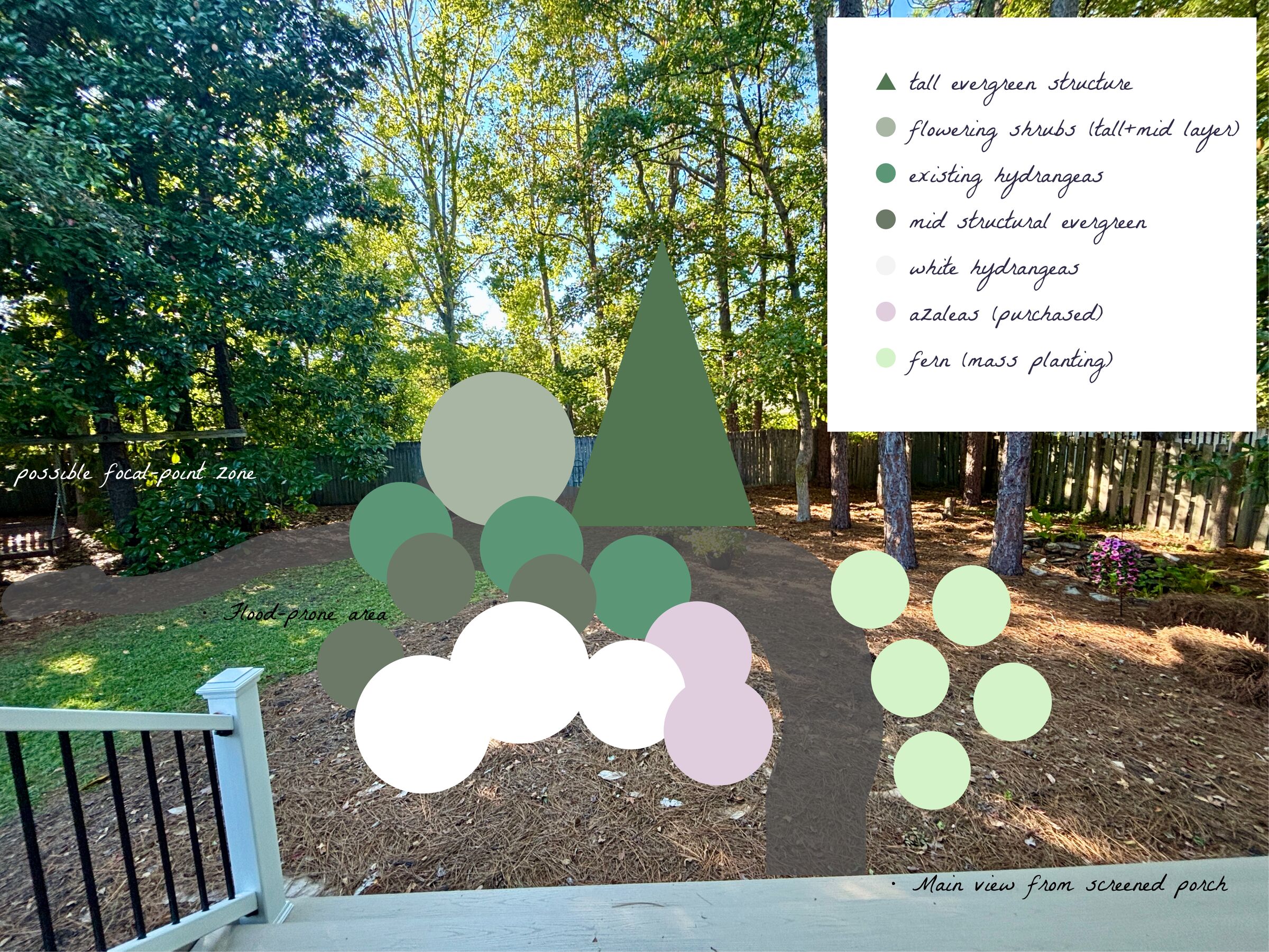
Keep the lawn as the open center.
Reshape its back edge into a softer curve and let the back bed come forward. The open green gives the eye somewhere to rest against the looser woodland planting.
Plant in three layers.
Use tall evergreen structure against the fence, a middle mass of evergreen and hydrangea, and a low layer of ferns, sedges, and shade perennials - repeated in groups, not scattered one of everything.
Run a loose flagstone path to the swing.
Set it into pine straw rather than gravel, which would trap leaves and create unnecessary maintenance. Let the path sit inside the planting so it also works as bed access.
Match plants to the moisture zones.
Use dry-shade-tolerant planting near the tree roots, moisture-lovers toward the low open edge, and leave the hardest spot beneath the magnolia as simple woodland floor.
Work with the plants already there.
A keep, move, or rethink plan means Rachel can strengthen the garden she has instead of starting over.
What she actually received.
After the session, Rachel received a written Garden Direction Summary: her own photos with the direction marked directly on them, a working plant palette organized by zone, and a short “start here” action plan.
Not a stack of inspiration photos - a document she can act from in her own garden.
The outcome was clarity.
Rachel arrived with a garden that felt chaotic and a pile of disconnected questions. She left understanding why it felt wrong, with a coherent structural direction, a real destination for the path she had always wanted, and a clear sense of which plants to keep, move, or rethink.
Have a space that feels off, but you cannot say why?
That is exactly what a Garden Direction Session is for. Bring me one ornamental space and we will find the reason it is not working - and a clear direction forward.
Tell me about your garden